Five ways to get more jobs from your website
Five things worth adding to a trade website to win more jobs, a five-minute check to see which you already have, and where to start. Plain English, no jargon.
- The check
- 3 questions, 5 minutes
- First two steps
- Free to do yourself
- Fix first
- Google Business Profile
- Written for
- UK trades and local services
Two plumbers in Coventry. Same qualifications, same prices, same standard of work. One has a diary full for three weeks. The other is quieter than he should be.
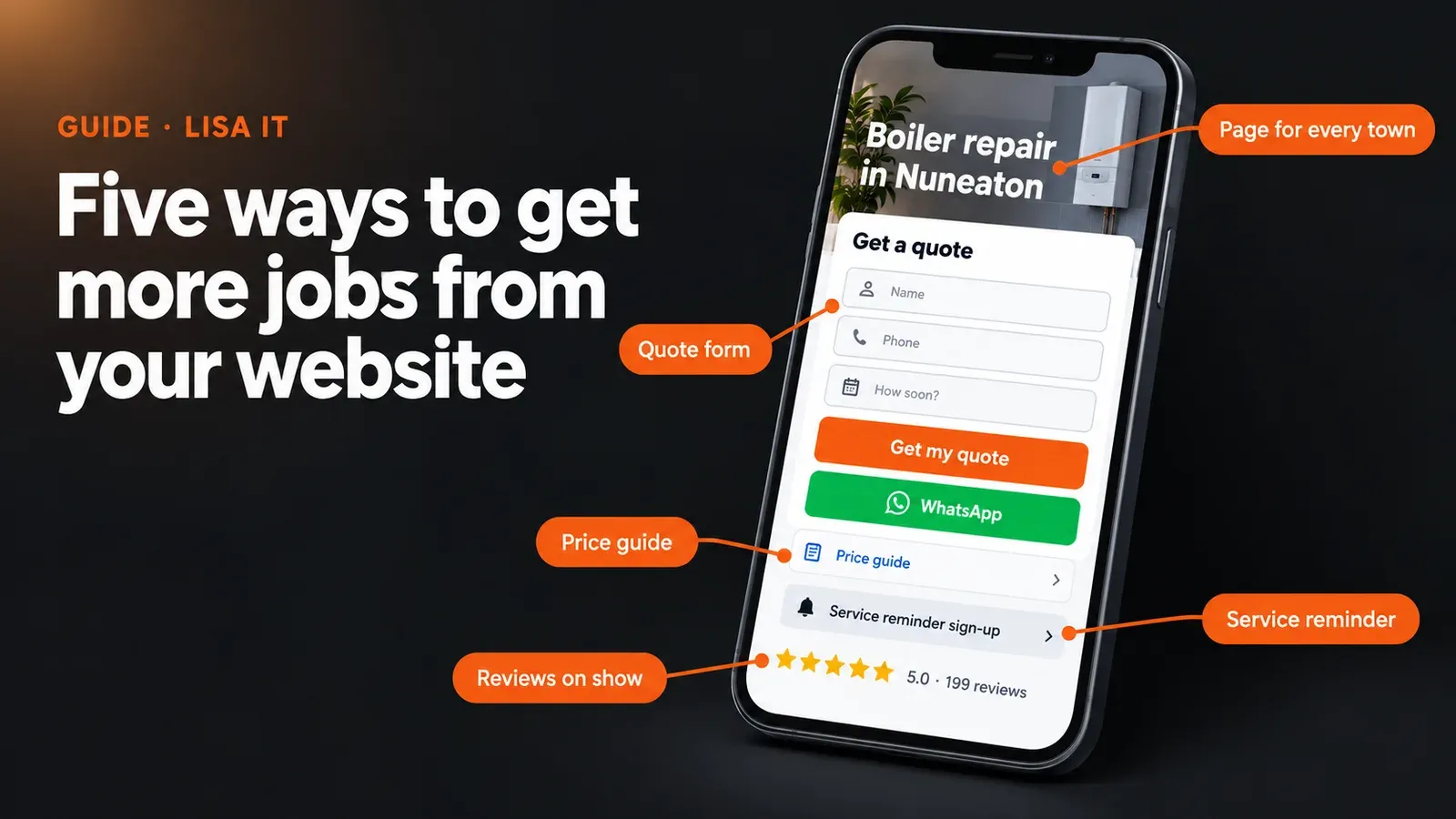
The difference is not the work. It is how easy each one makes it for a customer to take the next step. One has a site where you can ask for a boiler quote at ten at night, sign up for a reminder when your service is due, and read a page about your own town. The other has a phone number in the footer.
We hear the same three things from tradespeople all the time. “My site’s out of date and I’m scared to touch it.” “It looks nice but it doesn’t bring in any work.” “When I stop posting on Facebook, the phone stops.”
None of those is a sign of a bad business. They are a sign of a website that was built to look right rather than to do a job, and the fix is usually a handful of additions rather than a new site. Below are five things worth trying, a five-minute walk through a site the way a customer sees it, and the order we would do them in.
Most trade websites are brochures, and that is how they were sold
When most tradespeople bought their website, a brochure was what was on offer: Home, About, Services, Contact, the logo, a few photos, a phone number. The person building it was paid to make it look right, and it probably does.
A brochure tells people you exist and looks the part. Then it leaves the visitor to decide what to do next, and most of them quietly do nothing.
Most visitors are not ready to ring. They are comparing three roofers on a Sunday night, or checking that the number a neighbour gave them belongs to a real business. The phone number serves the ones who ring straight away. It is everyone else the site is missing.
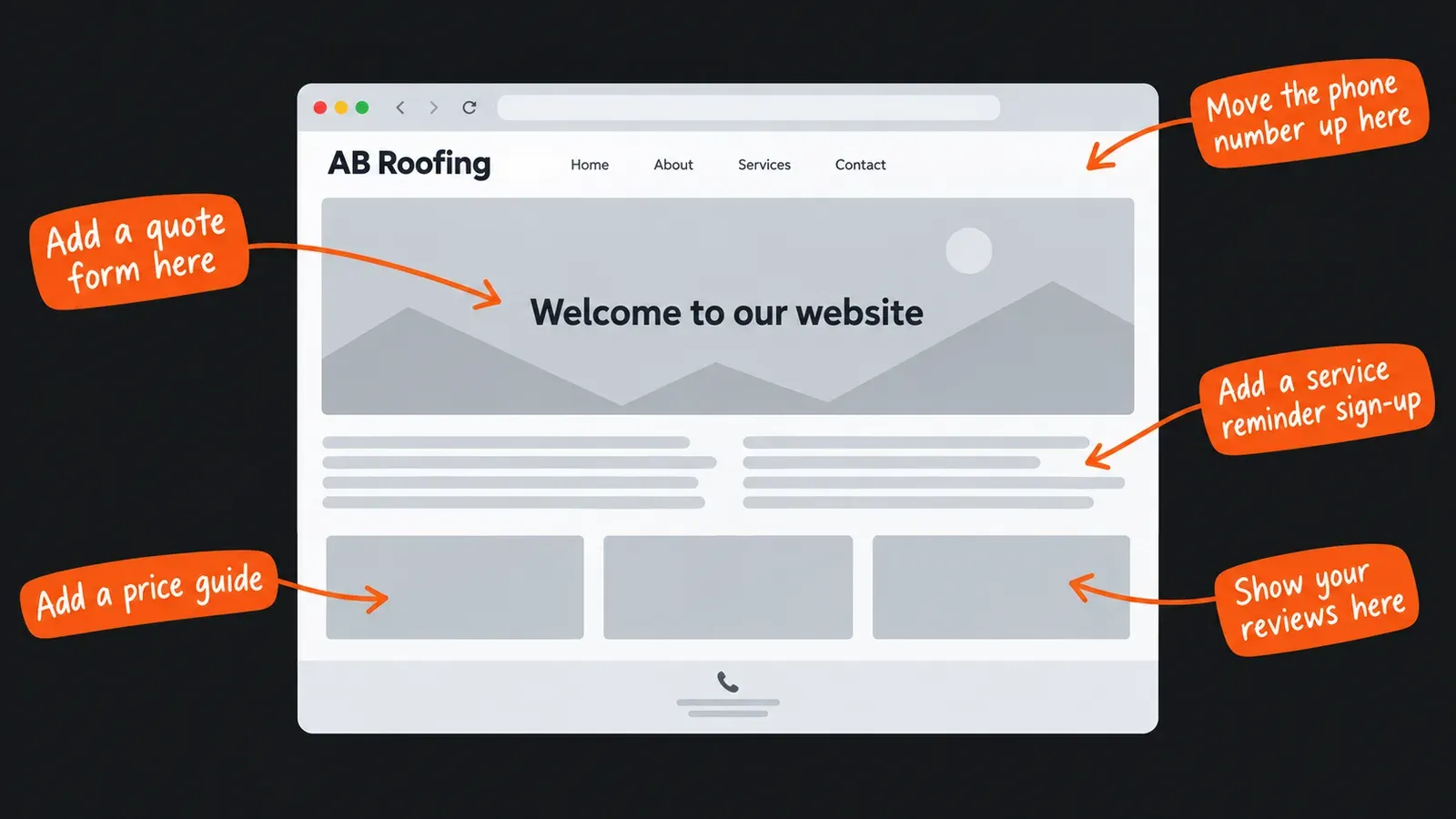
Every place a customer can take a step with you is a collection point: a call button, a quote form, a booking link, a price guide, a reminder list, a review page. The more of these a site has, the more of those Sunday-night visitors turn into Monday-morning enquiries.
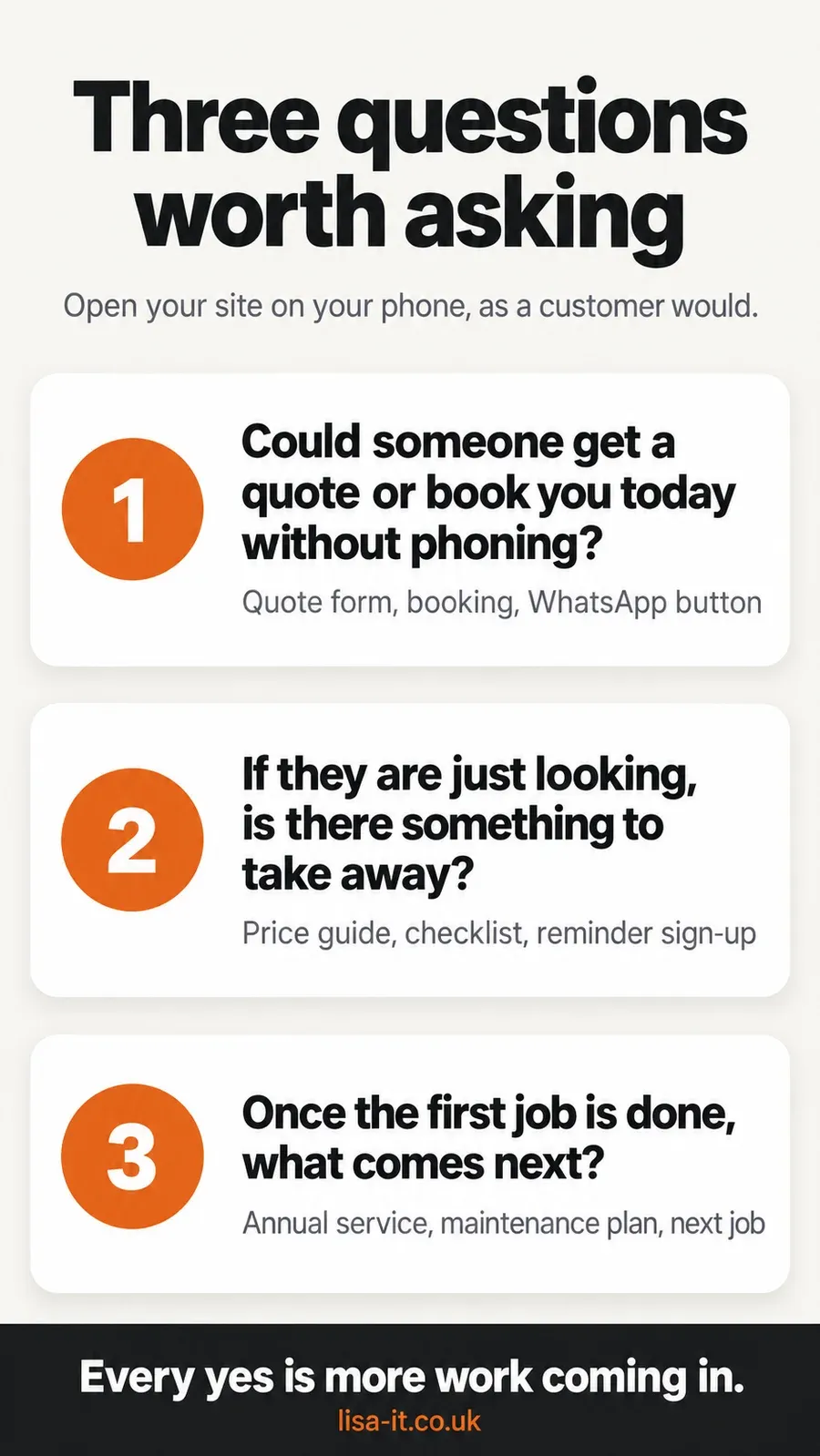
The five-minute check: three questions
Open your site on your phone as if you were a customer who found you ten minutes ago, and ask three questions.
- Could I get a quote or book you right now without phoning? A short quote form, a booking calendar, a WhatsApp button, an instant estimate. If the only option is “call us”, a customer who is at work, on a train, or who would rather not ring a stranger moves on to the next name, simply because it was easier.
- If I am just looking, is there anything I can take away? A price guide, a “what to ask before you hire a roofer” page, a boiler service reminder they can sign up for. Something useful enough that they leave a number or an email, so the next step is yours to take rather than theirs.
- Once the first job is done, what comes next? An annual service, a maintenance plan, gutters after the roof, an EV charger after the rewire, a reminder next spring. A customer who already trusts you is the easiest one to win again.
If one or two of the answers are “no”, you have found the gaps, and they are usually quick to fill. If all three are “no”, you are in good company. That is where most trade sites start, including plenty we have been asked to rebuild.
Collection points, trade by trade
The right collection points depend on the trade. Here are some that work, with two live sites you can click through:
| Trade | Book or quote today | Take away if not ready | Next job |
|---|---|---|---|
| Plumber / heating | Emergency call button, boiler quote form | Annual service reminder sign-up | Service plan, landlord certificates |
| Electrician | Fixed-price job list with “book this” | EICR explainer with a price range | EV charger, smart heating |
| Roofer | Free survey booking | ”Is my roof due?” checklist | Gutter clearing, moss treatment |
| Jet wash / drive cleaning | Quote form with photo upload | Before-and-after gallery by town | Sealing, annual re-clean |
| Locksmith | Call now button pinned on mobile | Home security checklist | Lock upgrades, insurance-grade locks |
| Cleaner | Instant price by number of rooms | End-of-tenancy checklist | Regular slot, oven or carpet add-on |
| Physio | Online booking | ”Should I see someone about this?” guide | Follow-up block, classes |
| Used-car dealer | Enquire on this car, finance calculator | Stock alert sign-up | Part exchange, servicing |
None of these need a big budget or a rebuild. A reminder sign-up is one box and a button. A checklist is a page you write once.
Rented roads and the home you own
Checkatrade, Bark, MyBuilder, Facebook groups, Instagram and Nextdoor are roads. They are good roads. They bring people past your door, and if one pays for itself it is worth staying on.
The catch is that you do not own the road. The fees change, the ranking rules change, accounts get restricted for reasons nobody explains, and the people on the road belong to the platform, not to you.
The home is what you own: your website on your own domain, your Google Business Profile, your reviews, and your list of past customers. Nobody can switch those off, change the rules, or charge you more for them next year.
Every road should point home. Your Facebook page, your Checkatrade listing and the side of your van should all carry your website address, and the website should give people a reason to leave their details.
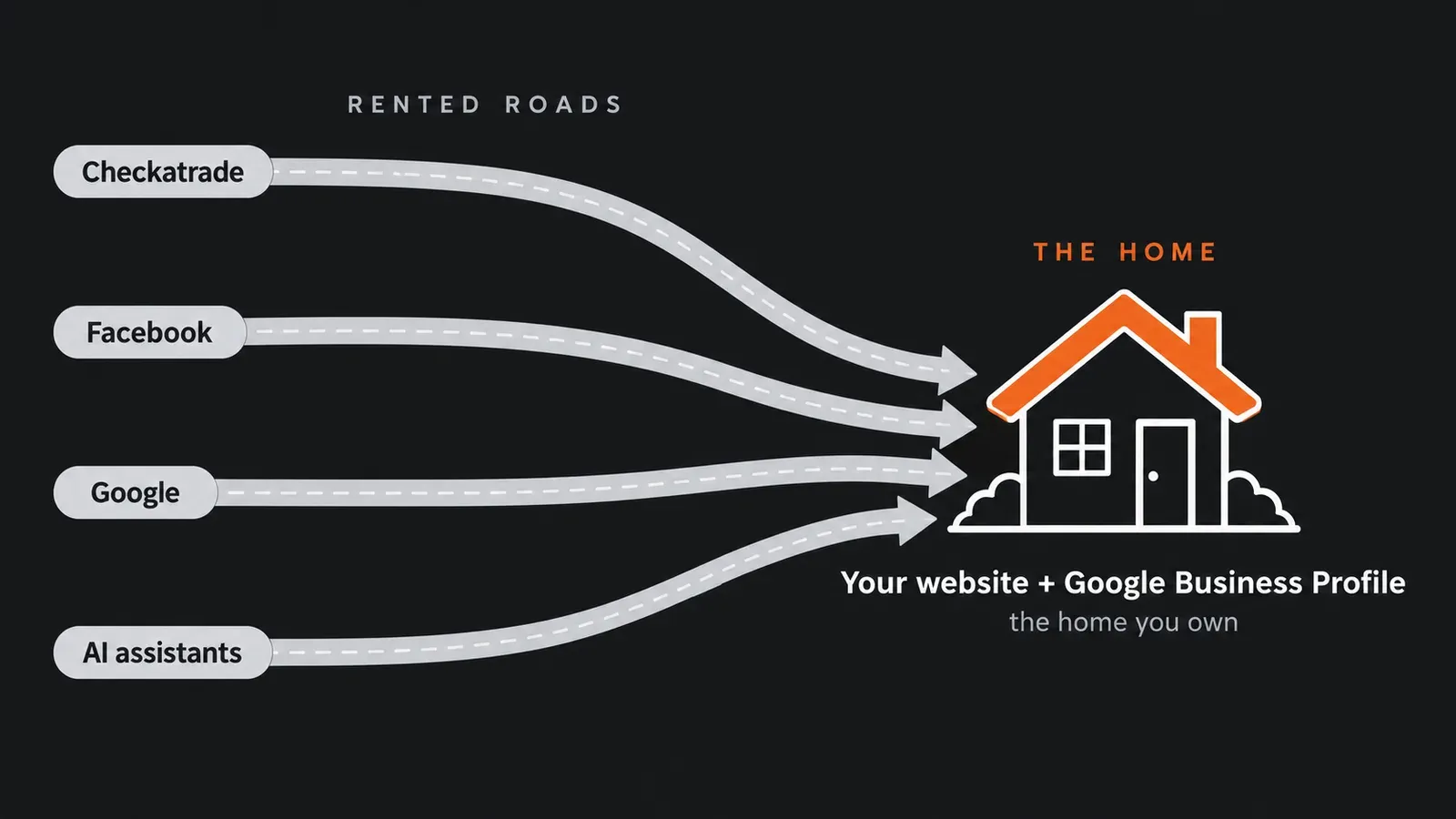
That is the whole explanation for “when I stop posting, the phone stops”. The leads lived on the road. Once some of them live in the home as well, the phone keeps going when you take a week off.
The homepage is the hallway, not the counter
The homepage has two jobs. First, prove you are real: reviews, photos of real jobs, accreditations, and a face. Second, send people to the right page.
The selling happens on single-purpose pages: one service, one town, one thing to click. “Boiler repair in Nuneaton” beats “Services” every time, because it matches what the customer typed and tells them in four words that you cover their patch.
Jon’s jet wash site has 26 town pages, each with the before-and-after gallery, the reviews and the same one-minute quote form. Trusted Motors has a page per car with an “ask about this car” form at the bottom, so every enquiry arrives with the car already named. Neither site makes anyone hunt for the next step.
This is why a five-page site can outperform a thirty-page one. The five pages each have one job. We build town pages the same way for every trade.
What’s changed: short lists, not ten blue links
Around six in ten Google searches now end without a click to any website, according to a 2024 study by SparkToro and Datos. Google answers more on the results page itself: the map pack, the reviews, and the AI summary at the top.
Ask ChatGPT, Gemini or Google’s AI for “a reliable electrician in Solihull” and you do not get ten links. You get two or three names and a sentence on each.
What decides whose names come up? A study of 75,000 brands by Ahrefs found that how often a business is mentioned across the web predicted appearing in Google’s AI answers far more strongly than backlinks did. For a local trade, mentions are your Google Business Profile, your reviews, the directories, your trade body, and a website that answers the questions customers actually ask. AI assistants pull from all of those, which is what our AI search work is about.
The customer still checks you out before they pay. They look at your website, your reviews and your photos, whichever road brought them. If the home is a brochure, the road has done its job and the site has not.
And the visitors that AI assistants send are worth having. Ruler Analytics tracked over five million conversions and found that visitors referred by AI converted at a higher rate than visitors from search, email, direct or referral, and on a par with paid search. Fewer people, but ready to act, and they need somewhere to land that you own.
Where to start
So, the five things: a way to book or quote today, something to take away, a next job, every road pointing home, and one page per service per town. Here is the order we would tackle them in. The first two cost nothing but an hour.
- Go through your site with the three questions. Write down what is missing. That list is your brief, whether you do it yourself or hand it to someone.
- Sort your Google Business Profile before anything else. It is the biggest road there is for a local trade, and the map pack is built from profiles, not websites. The top three results take nearly half of all clicks.
- Then give the roads somewhere to land. A website with one page per service per town, a quote form people actually finish, and your reviews on show.
Fix the home first. Then open the roads.
Asked and answered
Do I need a new website or can mine be fixed?
Often it can be fixed. Walk through your current site with the three questions: if the pages are sound and only the collection points are missing, a quote form, a price guide and a reminder list can be added to what you have. If the site is slow, hard to edit or built on a template nobody can touch, a rebuild is usually quicker and cheaper than patching it.
Should I fix my website or my Google Business Profile first?
Your Google Business Profile, for a local trade. The map pack is built from profiles, not websites, so an unclaimed or incomplete profile keeps you out no matter how good the site is. Sort the profile, then give it a website worth sending people to.
Will this get me recommended by ChatGPT?
Nobody can guarantee what an AI model says, and we would not trust anyone who claims otherwise. AI assistants pull from your website, your Google Business Profile and your reviews, so the same groundwork that wins local search is what they draw on. Doing it gives you a real chance where a messy or missing online presence gives you none.